
Blog
Your GTM Playbook Has To Work Across Buying Networks
AI-assisted research and third-party validation are changing how B2B buyers build shortlists.
Nov 17, 2025 • 5 min read
On this page
The traditional B2B funnel assumed a buyer moved through a path the vendor could mostly see.
That was always optimistic. Now it is plainly outdated.
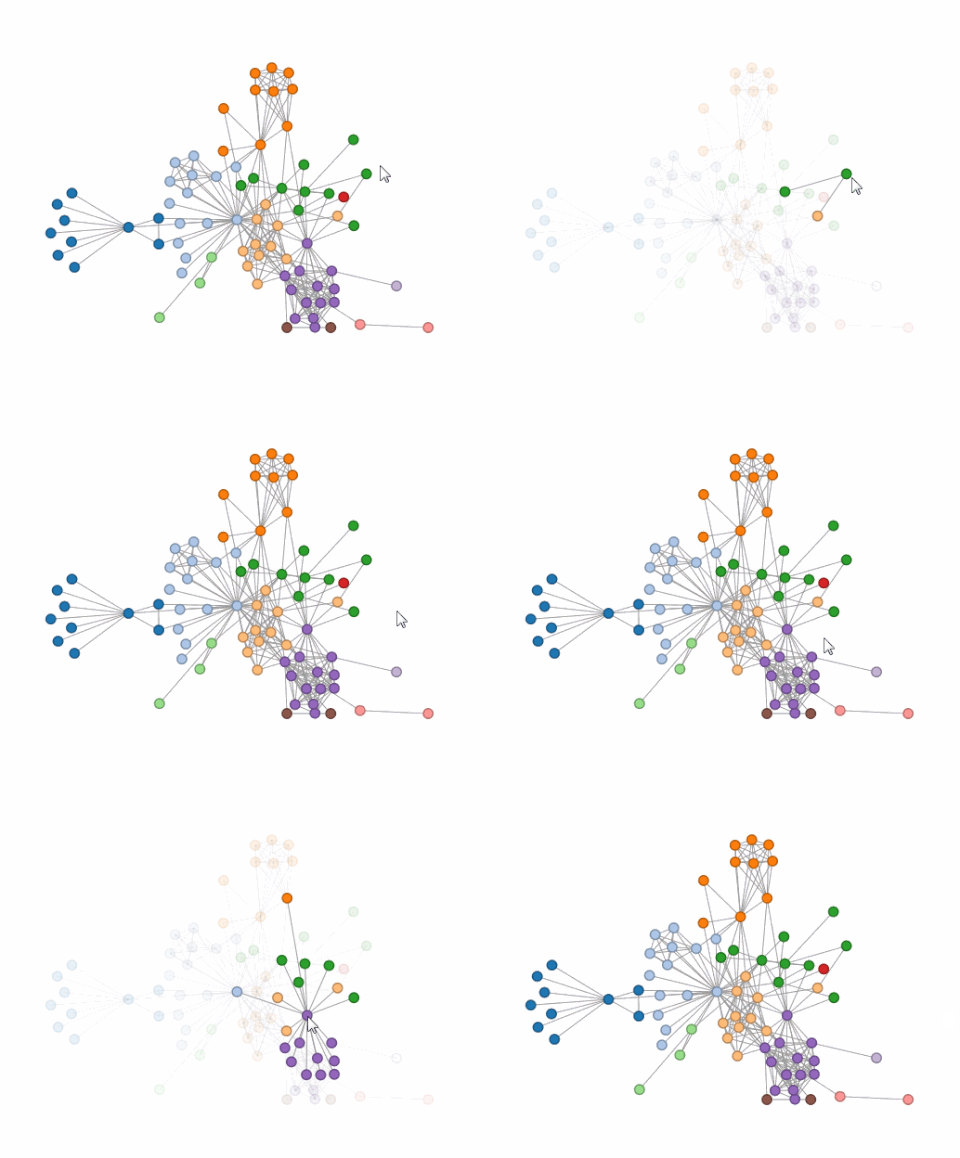
Modern buyers operate inside buying networks. They talk to peers, search independently, read review sites, ask analysts, scan social proof, and use AI assistants to summarize choices. The vendor is only one node in that network.
If your go-to-market playbook still assumes a single persona moving cleanly from awareness to demo, it is underbuilt for how decisions actually happen.
AI Is Becoming A Research Layer
Generative AI is not just helping marketers write content. It is helping buyers interpret markets.
A buyer can ask which vendors to consider, what questions to ask, what risks to watch for, and how one product compares with another. That answer may be incomplete, but it still shapes the buyer's first frame.
This changes the marketing job.
You are no longer optimizing only for a person clicking a result. You are also trying to be understood accurately by the systems and sources that summarize the market for that person.
That requires clearer positioning, cleaner proof, and stronger third-party validation.
Trust Beats Volume In A Networked Journey
When buyers rely on networks, volume outreach loses power.
More emails do not solve a trust deficit. More nurture does not fix weak proof. More content does not help if the content sounds like every other vendor in the category.
What works better is precision:
- Showing up where the buyer already looks for validation
- Publishing evidence that a champion can forward internally
- Making product facts easy to find and verify
- Mapping content to committee concerns, not just funnel stages
- Using signals to understand account motion before outreach
The goal is not simply to reach the buyer. The goal is to become credible inside the buyer's network.
From Personas To Network Playbooks
Personas still help, but they are not enough.
A modern GTM plan should map the broader influence system around the deal:
- Economic buyer
- Day-to-day operator
- Technical reviewer
- Security or compliance stakeholder
- Finance or procurement partner
- Peer sources and communities
- Review sites and analyst content
- AI-generated summaries and answer engines
Each node has different questions. Each node needs different proof.
That is why campaign planning has to connect audience, message, proof, offer, and channel in one operating view. Otherwise, teams create scattered assets that do not support the actual buying network.
Make Evidence Machine-Readable And Human-Useful
Agent-aware content is not a gimmick. It is practical hygiene.
Important pages should state what your product does, who it is for, what it replaces, where it fits, and where it does not. They should include structured facts, direct answers, implementation expectations, security notes, and customer proof.
That helps humans. It also helps AI systems summarize you with less distortion.
If the market is going to compress your story, give it a story that survives compression.
New Metrics For Network Influence
Classic metrics still matter, but they do not tell the whole story.
Add indicators such as:
- Third-party mentions
- Review momentum
- Branded search growth
- Content references in sales calls
- Proof asset usage in active opportunities
- Shortlist appearance by segment
- Conversion quality by account signal
These metrics help show whether marketing is influencing the network around the deal, not just generating names.
The PlaybookM Takeaway
Buying networks reward teams that coordinate trust, proof, and timing.
That is hard to do when campaign work lives in separate docs, spreadsheets, chat threads, and calendars. GTM teams need one place to connect target accounts, signals, content, proof, and execution.
The companies that win will not be the ones that interrupt buyers most often. They will be the ones buyers, peers, and AI systems can understand and trust fastest.