
Blog
Embracing Imperfections: Kintsugi, Antifragility, and the Beautiful Fragility of Marketing
What Kintsugi and antifragility teach us about leadership & Marketing: embracing imperfections, thriving on disruption, and finding strength in the cracks. Perfection is the enemy of good enough and modern marketers need to learn to use the realities—not the ideals—of businesses.
Dec 15, 2025
On this page
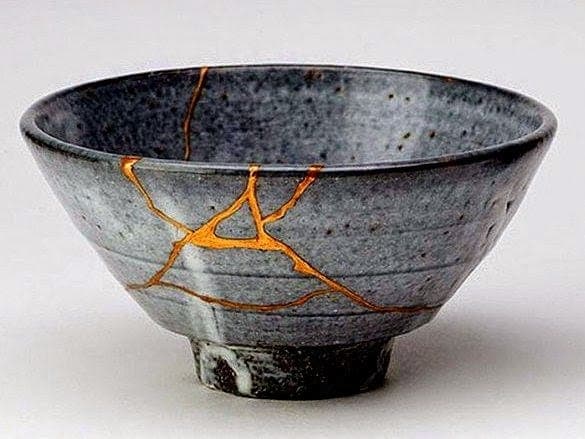
In the cracks of broken pottery, the Japanese art of Kintsugi reveals a quiet truth: perfection is a myth, and beauty often hides in what’s damaged. Rather than disguising the breakage, Kintsugi binds the pieces with lacquer mixed with gold dust—transforming flaws into features. The result is not restoration to former glory, but elevation into something more meaningful. It is a celebration of scars, of the history carried in every fracture.
This philosophy resonates in today’s complex world of marketing—a field that is, by its nature, fragile. Campaigns flop. Messaging misses. Algorithms change. Audiences evolve overnight. There is no perfect formula. We operate in shifting sands, constantly testing, learning, adjusting—always a bit broken, always trying to hold the pieces together. And yet, somehow, we create something extraordinary.
This is where antifragility, as introduced by Nassim Nicholas Taleb in Antifragile: Things That Gain from Disorder, meets Kintsugi. If Kintsugi teaches us to see beauty in what has cracked, antifragility shows us how to become stronger because of those cracks. It is not about withstanding pressure—it’s about thriving because of it. These are not romantic ideals. They are survival strategies.
The Fragility of Marketing Meets the Power of Antifragility
Marketing is a discipline that rarely moves in straight lines. Strategies unravel. Trends outpace plans. Metrics blur the truth. In this chaos, perfection is not only unattainable—it’s irrelevant. What matters is how we respond when things fall apart.
Kintsugi reminds us that a fractured campaign, a misstep in execution, or even a failed product launch can still serve as the foundation for something better. Antifragility challenges us to go further: to seek out volatility, tension, and failure as essential fuel for reinvention.
Both ideas offer a new lens for navigating disruption: one that accepts fragility as a starting point—not a flaw to fix, but a condition to build from.
Marketing Through the Lens of Imperfection
The origin of Kintsugi dates back to the Muromachi period, when a Shogun sent his cracked tea bowl for repair and found the result with metal staples unsatisfying. The art of Kintsugi emerged as a more honest response—a transformation, not a cover-up.
That same principle applies to marketing in the AI era. From privacy regulations to algorithmic shifts to global events, we are constantly repairing and reshaping. We are not assembling perfect machines—we are crafting vessels from broken parts.
To lead in this environment requires more than strategy. It demands a mindset shift: one that acknowledges fragility and harnesses it.
Leading with Antifragility
Leadership in marketing today isn’t about having the answers—it’s about building systems that adapt, learn, and even benefit from uncertainty.
Here’s how leaders can integrate antifragility, especially in fragile, creative environments:
1. Show the Cracks Great marketing doesn't pretend. It connects because it’s real. Leaders should be honest about what isn’t working—and let teams find the gold in the gaps.
2. Make Failure Productive In fragile systems, failure is fatal. In antifragile ones, failure is formative. Encourage experimentation. Track what flops, and mine it for insight.
3. Invite Many Hands Marketing is a mosaic. The more voices, the stronger the pattern. Embrace diverse thinking across functions and experience levels—especially when things break.
4. Build Loose, Not Tight Overengineered systems collapse under stress. Leave room for improvisation. Encourage flexible thinking. Let your teams operate with just enough structure to support innovation.
5. Honor the Journey Marketing success is rarely linear. Learn to appreciate the winding path. Celebrate the iterations, the rewrites, the rebrands—not just the wins.
Lessons for a Messy Future
Kintsugi and antifragility are not about restoration. They are about elevation. They teach us that nothing remains pristine—and that’s not just okay, it’s powerful. In marketing, especially, this is our lived reality. Campaigns will crack. Teams will stumble. Markets will shift. AI will upend what we thought we knew.
But if we build systems that learn, bend, and strengthen through pressure, we don’t just survive—we get better.
As Matt O’Neill notes, antifragile leadership is a necessary compass in today’s turbulent world. It’s time we stop striving for polished perfection and instead invest in the art of resilient imperfection.
In a future shaped by AI and accelerated change, fragility isn’t the enemy. Denying it is.
So the question is not how to avoid the cracks—but how to gild them. Will we pretend they never happened, or will we make them part of the story?
---
References
1. Kintsugi – The Art of Embracing Damage 2. *Antifragile: Things That Gain from Disorder* by Nassim Nicholas Taleb 3. Matt O’Neill on Antifragility in Leadership 4. AI and Organizational Resilience – Harvard Business Review 5. Original Blog Post – Kintsugi + Antifragility + Leadership